Art in Second Life 2023 (6) Guernica by London Junkers

Almost one year ago I visited London Junkers installation “Harriet Tubman – Hero” at The Eye Arts (read here). When I got an invitation to see his newest installation “Guernica“, I was curious to see it. I went there Saturday, January 21st.

Guernica” is an installation that remembers the attack on the town Guernica back in 1937 and is a tribute to Pablo Picasso’s famous large oil painting also named “Guernica”.

Guernica is one of Picasso’s best-known works, regarded by many art critics as the most moving and powerful anti-war painting in history. It is exhibited in the Museo Reina Sofía in Madrid. 
The grey, black, and white painting, on a canvas 3.49 meters (11 ft 5 in) tall and 7.76 meters (25 ft 6 in) across, portrays the suffering wrought by violence and chaos. Prominent in the composition are a gored horse, a bull, screaming women, a dead baby, a dismembered soldier, and flames. Picasso painted Guernica at his home in Paris in response to the 26 April 1937 bombing of Guernica, a Basque Country town in northern Spain that was bombed by Nazi Germany and Fascist Italy at the request of the Spanish Nationalists. Upon completion, Guernica was exhibited at the Spanish display at the 1937 Paris International Exposition, and then at other venues around the world. The touring exhibition was used to raise funds for Spanish war relief. The painting soon became famous and widely acclaimed, and it helped bring worldwide attention to the 1936-1939 Spanish Civil War.
(source wikipedia)
Impressions of “Guernica” by London Junkers (1)

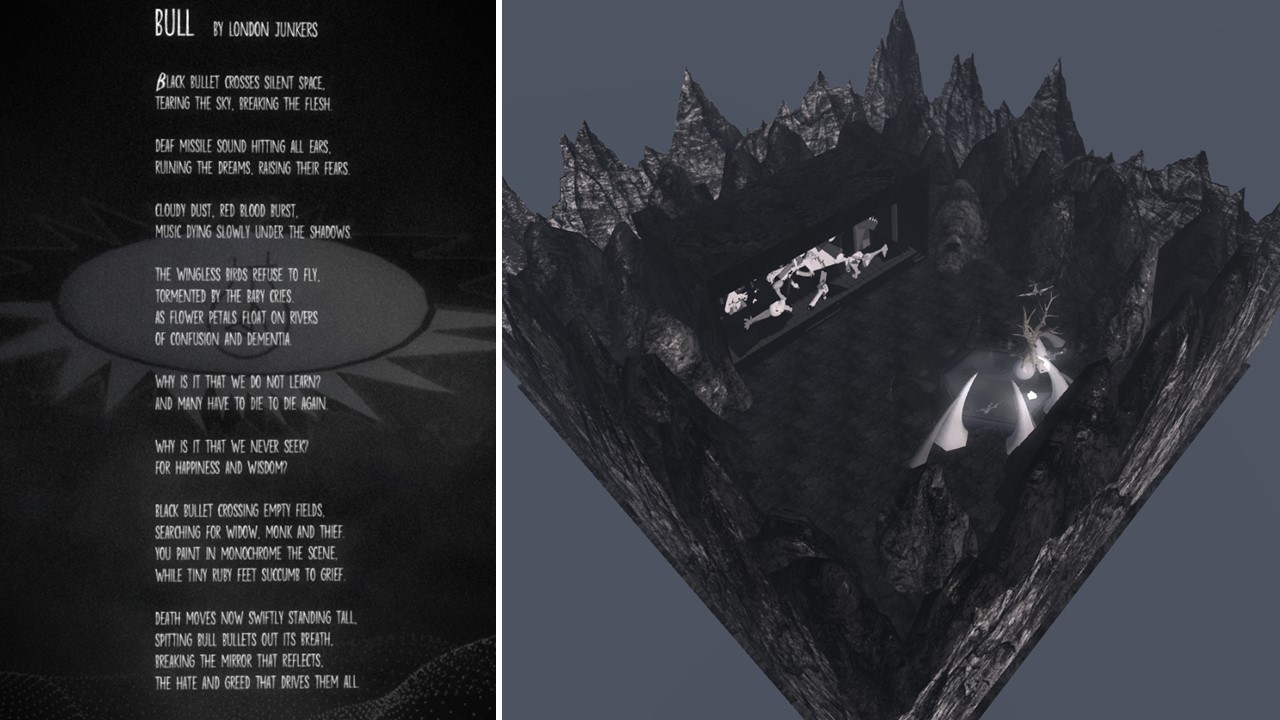
London Junkers’ installation consists of two 3D ensembles. One shows the attack of the town Guernica in 1937, the other is a 3D model of the famous painting on Picasso. London added two boards. One board is about the history of the attack and about Pablo Picasso’s painting. There London also has some quotes of Picasso.
The second board is a poem of London fitting to the anti-war theme of his installation and to the bullets fired from the airplanes.

BULL
by London Junkers

Black bullet crosses silent space,
Tearing the sky, breaking the flesh.

Deaf missile sound hitting all ears,
Ruining the dreams, raising their fears.

Cloudy dust, red blood burst,
Music dying slowly under the shadows.

The wingless birds refuse to fly,
tormented by the baby cries.
As flower petals float on rivers
of confusion and dementia.

Why is it that we do not learn?
And many have to die to die again.

Why is it that we never seek?
for happiness and wisdom?

Black bullet crossing empty fields,
searching for widow, monk and thief.
you paint in monochrome the scene,
while tiny ruby feet succumb to grief.

Death moves now swiftly standing tall,
Spitting bull bullets out its breath,
breaking the mirror that reflects,
the hate and greed that drives them all.

Impressions of “Guernica” by London Junkers (2)

The 3D model of Picasso’s painting is intriguing as you can walk through it and even become part of it. London added a third dimension. Nonetheless you can recognize the painting immediately. What you see in it (both in the painting and in the 3D model) is in the eye of the visitor of course. For me personally it expresses the madness and uselessness of war. Unfortunately that is something that had become so near to us in Europe and that also started with a surprising hostile attack. Picasso’s picture has become very persent again.
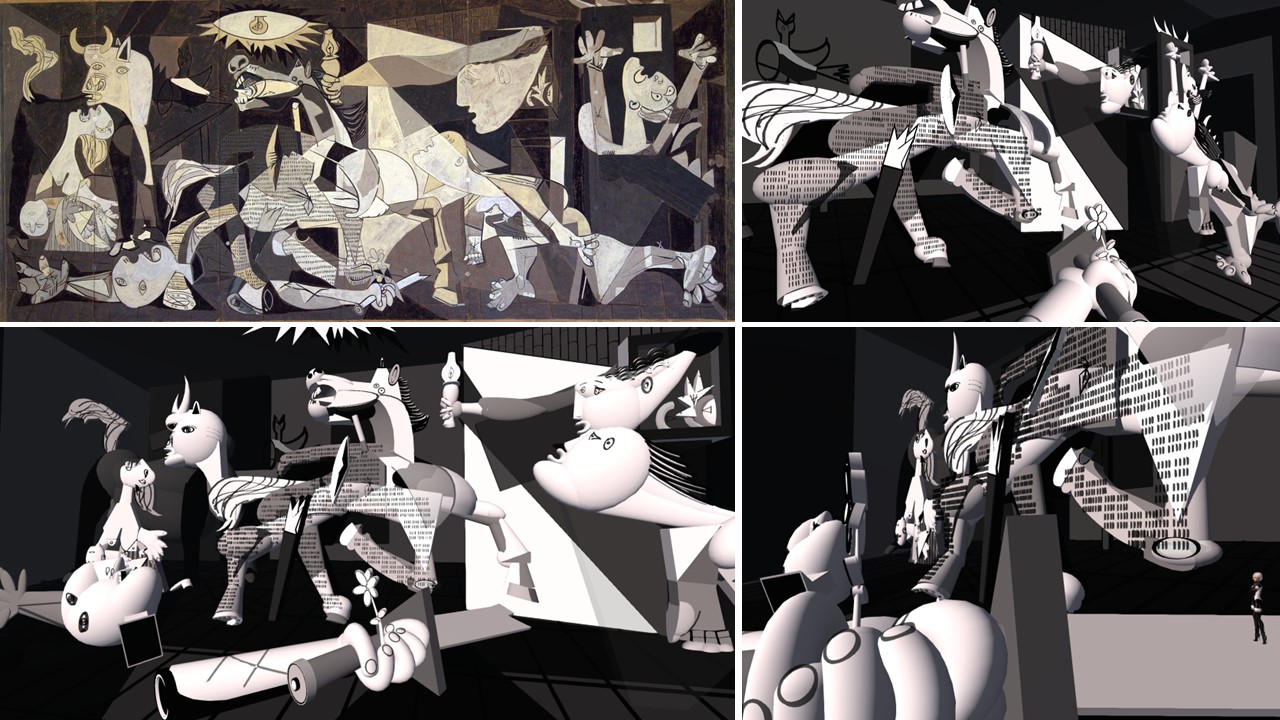
Impressions of “Guernica” by London Junkers (3) (upper left is Picasso’s picture, all others are London Junkers 3D model)

Thank you London for this installation, for the poem and for pointing us to Picasso’s picture in this day and age. I appreciate your poem and the installation. Well done!

Landmark to Guernica by London Junkers
http://maps.secondlife.com/secondlife/Montague%20Island/72/140/3510

Art in Second Life 2022 (10) Harriet Tubman – Hero by London Junkers

I got an invitation from London Junkers to see his latest installation “Harriet Tubman – Hero” at The Eye Arts.
The Eyes Art is another place for the art, unknown to me until now: “an open, free and shared space where the diversities disappear. The opportunity to look at Art with multiple eyes and infinite visions in the real, dreamlike and virtual world. You are welcome to be part of it.

London adviced me turn Advanced Lighting Model on (I have that turned on always anyway) and to set my environment to sunset. But the most important hint he gave me was to read the poem at the fireplace first.
London Junker’s installions are visualisations of poems. I saw his installations “Thunderous Train Of Air” (read here) and “Marking the Twain” (read here) in 2021.

The landmark brought me directly in front of the above mentioned fireplace. It’s not just a fireplace, it looks like the center of a living room in an old luxury manor. At the right sight you find a stand with an open book – the poem.
The poem is a dedicated to the life and the work of Harriet Tubman. Those who are familiar with American history might have heard of her – I haven’t heard about her so far and looked her up on wikipedia. The entry is quite long and a lesson in history. But for the understanding of the poem and the istallation is is important to know about it.

London Junkers poem about Harriet Tubman – Hero

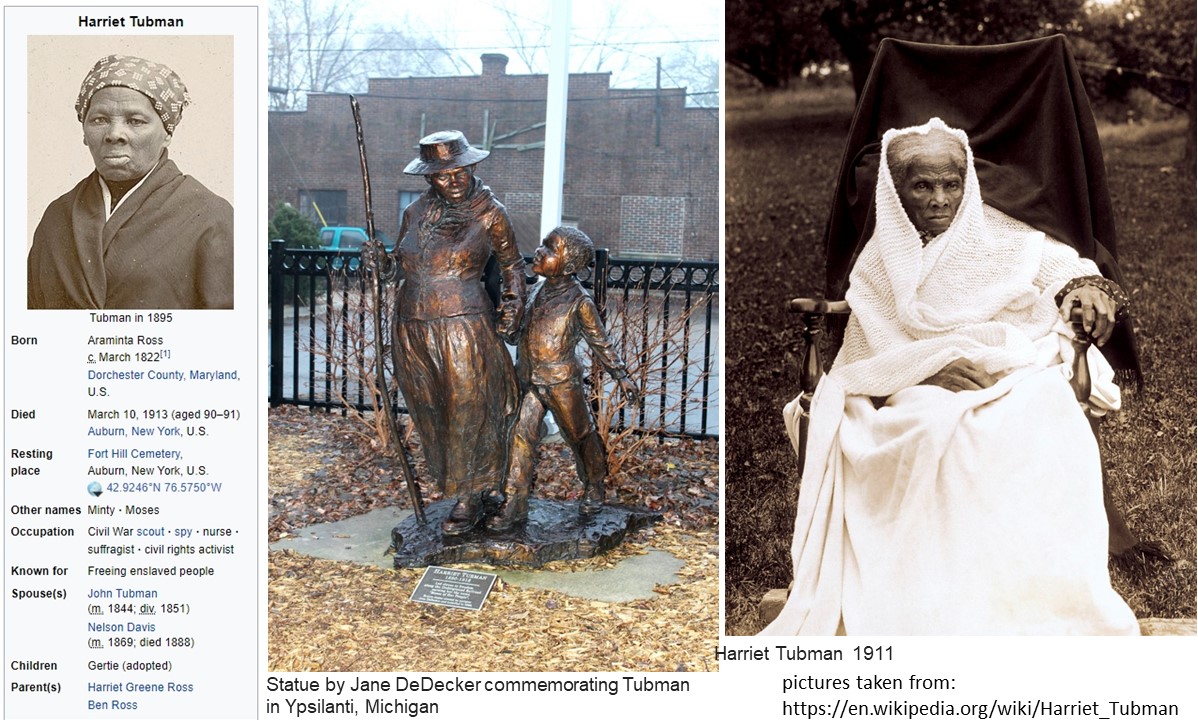
Harriet Tubman (1822 – 1913) was an American abolitionist and political activist. Born into slavery, Tubman escaped and subsequently rescued approximately 70 enslaved people, including family and friends. During the American Civil War, she served as an armed scout and spy for the Union Army. In her later years, Tubman was an activist in the movement for women’s suffrage.

Born enslaved in Dorchester County, Maryland, Tubman was beaten and whipped by her various masters as a child. Early in life, she suffered a traumatic head wound when an irate overseer threw a heavy metal weight at her head. The injury caused dizziness, pain, and spells of hypersomnia, which occurred throughout her life. After her injury, Tubman began experiencing strange visions and vivid dreams, which she ascribed to premonitions from God. These experiences, combined with her Methodist upbringing, led her to become devoutly religious.

In 1849, Tubman escaped to Philadelphia, only to return to Maryland to rescue her family soon after. Slowly, one group at a time, she brought relatives with her out of the state, and eventually guided dozens of other enslaved people to freedom. Traveling by night and in extreme secrecy, Tubman (or “Moses”, as she was called) “never lost a passenger”. After the Fugitive Slave Act of 1850 was passed, she helped guide fugitives farther north into British North America (Canada). Tubman met John Brown in 1858, and helped him plan and recruit supporters for his 1859 raid on Harpers Ferry.

pictures taken from wikipedia https://en.wikipedia.org/wiki/Harriet_Tubman

In the American Civil War she was the first woman to lead an armed expedition in the war, she guided the raid at Combahee Ferry, which liberated more than 700 enslaved people. After the war, she retired to the family home on property she had purchased in 1859 in Auburn, New York, where she cared for her aging parents. She was active in the women’s suffrage movement until illness overtook her, and she had to be admitted to a home for elderly African Americans that she had helped to establish years earlier. She became an icon of courage and freedom.
(excerpt from wikipedia entry about Harriet Tubman)

With this background and the poem London Junkers’ installation can develop it’s fascination. With just a few scenes brought together into one installation, London visualized Harriet’s life and the poem, that he wrote about her.

Impressions of “Harriet Tubman – Hero” by London Junkers at The Eyes Art (1)

There is the luxury living room with the entrances to mines on it’s left and right side, that might symbolize the contrast between the lifes of the black slaves and their owners on one side of the installation. It is seperated with a huge wall from the outside. On the other side you see Harriet Tubman as a larger-than-life angelic figure with a pregant woman and two children at her feet. One child is still carrying broken chains. From the left and the right side wolfs are attacking and bullets fly through the air, symbolizing Harriet’s work rescuing other slaves and bringing them into security during the Civil war.

Impressions of “Harriet Tubman – Hero” by London Junkers at The Eyes Art (2)

London Junkers’ installation “Harriet Tubman – Hero” stands against slavery, against opression and is a tribute to a real brave woman. Thank you London for this installation, for the poem and for remembering us, that nothing is a given and that everyone can make a real difference. And thank you all at “The Eye Arts” who were involved in enabling this installation. I enjoyed my visit and writing about it.

During my little research I also came across another blog entry about “Harriet Tubman – Hero” by London Junkers in the artcorner blog.

Landmark to “Harriet Tubman – Hero” by London Junkers at The Eye Arts
http://maps.secondlife.com/secondlife/Gigli%20Waves/43/240/3147
Wikipedia entry about Harriet Tubman
https://en.wikipedia.org/wiki/Harriet_Tubman
Artkorner blog entry about “Harriet Tubman – Hero” by London Junkers
https://artkornersl.com/2022/01/22/hero-inspiring-installation-london-junkers/